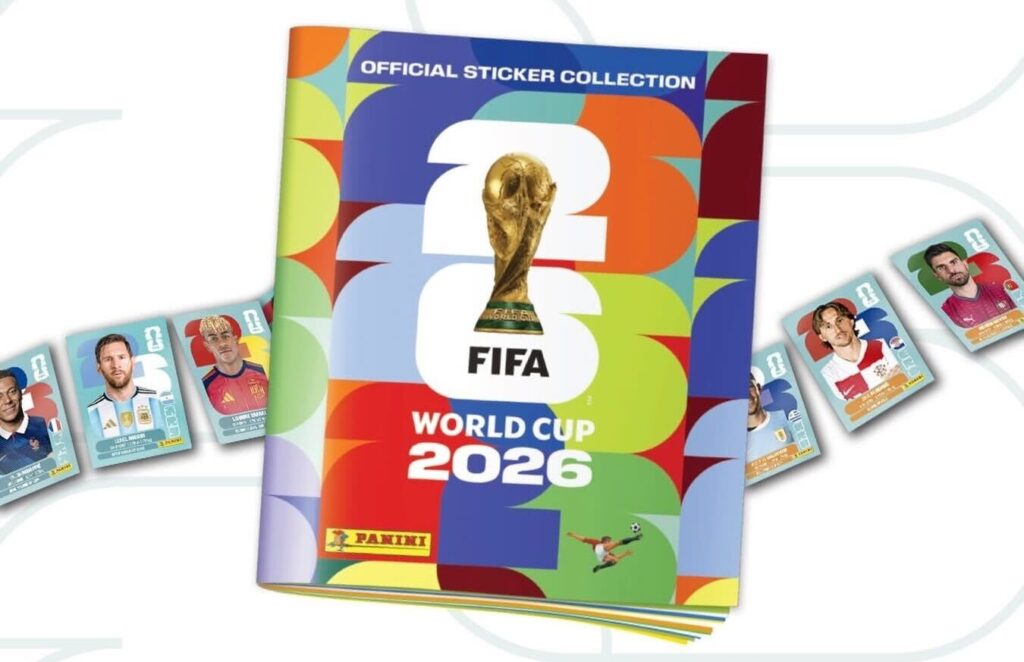
Since 1970, when Italian collectibles company Panini launched its first official World Cup sticker collection in Mexico, the brand has focused on churning out collectible sticker albums for each subsequent World Cup. In Colombia, the tradition has deep roots.
“I believe that [in Colombia], there is a very deep-rooted culture of collecting. People collect toy cars, dolls, and jerseys; therefore, the Panini football album is no exception,” sports journalist Diego Chiriví told The Bogotá Post.
Although the global fever began in the ‘70s, it was during the 1980s and, especially, during the 1990 World Cup, that the ritual became a national phenomenon in the country.
“We are one of the top five countries in the world for sticker sales. For us, Panini is a tradition—a legacy we share from generation to generation with every World Cup,” Luis Felipe Gallego, Commercial Vice President at Continente (Panini’s official distributor in Colombia), told The Bogotá Post.
Initially, completing the album was an activity reserved for specialized football fans. However, over the decades, this hobby has expanded its reach, becoming a massive social phenomenon that now captures the country’s attention.
This shift solidified in 2014, when the collection moved from being a niche hobby to a popular tradition.
“In 2014, the Colombian National Team united the entire country. The team represented hope, reaching the quarter-finals for the first time in history. When they returned, over a million people welcomed them in Bogotá. It was the most unforgettable team of this generation, and since then, the ‘fever’ for the Panini album has only grown,” said Chiriví.
Read more from 2014: Panini Madness Strikes
Indeed, this passion has moved from private collections to the streets, becoming a social ritual where ‘cambiatones‘, or sticker swaps, take center stage.
These massive gatherings in parks and shopping malls have turned the hobby into a collective mission, where people of all ages trade ‘monas‘ (stickers) to complete their albums.
“It’s a family tradition—grandparents, uncles, parents, everyone is involved,” explained Elie Milhem, Panini’s CEO in Colombia. “People love seeing which players will make it to the World Cup, and that passion has made us one of the top ten countries for Panini sales in the world.”
The “repetidas” (duplicates) are what make the hobby exciting. Even though every sticker is printed in the same quantity, the random packs make some feel impossible to find. This struggle is what pushes people to meet and trade, turning the album into a competitive race to see who can finish first.
This year, the challenge is bigger than ever. For the first time in World Cup history, 48 teams will participate, meaning the album now features 112 pages and 980 stickers. This massive scale makes completing the collection an even more difficult mission for fans.
The stickers also come in four different versions: gold, silver, bronze, and the common ones. The gold, silver, and bronze versions are considered real treasures because they are much harder to find. Getting one of these in a pack feels like winning a prize, and they are often the most valuable pieces to trade during the ‘cambiatones.’
“I would say the Lionel Messi sticker, in any of its years, but especially the 2018 Russia version, was incredibly tough to find,” Chiriví shared. “In 2022, it was much easier, but because of what happened four years prior, the 2018 Messi sticker became almost impossible.”
Surely, Colombians will be on the hunt this year as their national team kicks off soccer’s biggest tournament facing Uzbekistan on June 17.