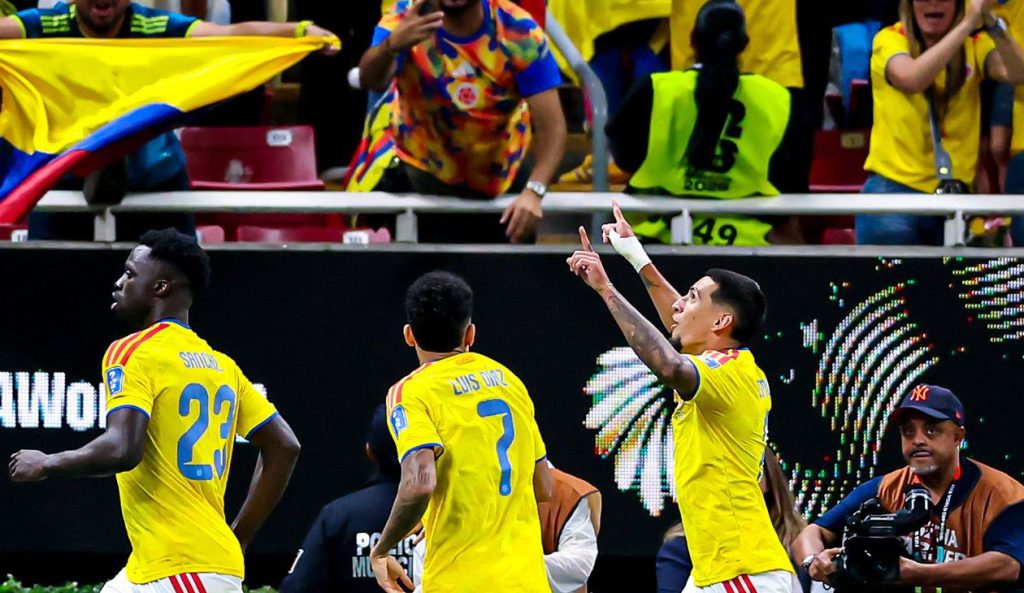
Despite Colombia’s election exposing a deep political divide, a common feeling is uniting citizens: World Cup fever.
Colombia’s football team, led by Argentine coach Néstor Lorenzo, has achieved its first two victories: one against Uzbekistan and the other against the Democratic Republic of Congo, becoming the leader of Group K and securing its ticket for the next challenge: the Round of 16.
Yet, one of the most awaited matches is scheduled for this Saturday, June 27, where Colombia will face Portugal. This game feels especially important, as it marks what is expected to be the ‘last dance’ for both legends, James Rodríguez and Cristiano Ronaldo, in a World Cup tournament.
“It’s a luxury to watch Colombia face someone like Cristiano Ronaldo. Honestly, I feel a mix of emotions because even though Portugal hasn’t been fully behind him, I know Cristiano still has a lot to prove,” said Andrés Vargas, a Colombian fan. “Still, I’m a true believer; I want my country to win. I’ve even seen fans from Spain and Brazil cheering for us, it’s incredible”.
The Colombian team’s recent wins have fueled hopes of reaching the trophy.
So far, the fans have really enjoyed the team’s performance, especially after the dramatic final goal against Uzbekistan when Juan Camilo ‘Cucho’ Hernández fought for a ball that seemed lost, got it back, and crossed it to Jaminton Campaz to score in the final minute.
Now, as its seventh World Cup appearance, Colombia fans want to surpass their historical performance: the quarter-finals reached in Brazil 2014.
Football fever can be felt in every corner of Colombia, where big screens have been set up by media outlets, city authorities, malls, and the Federación Colombiana de Fútbol.
Commercially, there have been public events for Panini sticker exchanges, national team merchandise sold on streets and at traffic lights, and brand activations encouraging citizens to support the players.
For example, Starbucks and Juan Valdez have created seasonal coffee preparations while Adidas, the brand in charge of producing the official team clothes, hosts regular activities for fans, including travel giveaways.
Games between friends are also part of the tradition, such as the famous “Pollas Mundialistas,” a betting system where guessing the scores of each World Cup game can lead to winning significant money.
Bogotá Fan Guide
In the capital city, bars, malls and night clubs across the city are preparing to welcome fans for the upcoming matches.
For those looking for a massive, high-energy party, locations like Parque de la 93, Parque Simón Bolívar, and Zona T are highly recommended. If you prefer something more cozy and private, restaurants like ‘La Cabrera’ or cinemas like ‘Viziona’ are offering a more luxurious experience.
Additionally, official “barras incondicionales” organized by the Federación Colombiana de Fútbol are set up in two major venues: Parque Metropolitano El Tunal in Tunjuelito, with an expected 15,000 attendees, and Parque Metropolitano Fontanar del Río in Suba, with 5,000.
For the awaited match between Portugal and Colombia, one of the concert venues known as “Vive Claro” is preparing a massive event, mixing a live concert with a giant screen for an audience of around 45,000 participants.
The ‘yellow wave’ beyond borders
The Colombian energy has also followed the football team abroad, with stadiums full of yellow jerseys, national ‘tricolor’ flags, and traditional accessories like ‘marimonda’ masks and ‘sombreros vueltiaos’.
In Mexico City, a massive crowd gathered at one of the most iconic landmarks: the Angel of Independence. The city turned yellow as thousands of fans met to show their support for the players. Many Mexicans joined them, and as seen in several videos circulating on social media, they expressed a strong feeling of brotherhood with the Colombians.
This is partly because of their shared cultural roots. For decades, people in both countries have listened to the same music, watched the same telenovelas, and celebrated the same figures. For example, the Colombian Nobel prize winning author, Gabriel García Márquez, wrote ‘One Hundred Years of Solitude’ while living in Mexico’s capital.
In Miami, the ‘Federación Colombiana de Fútbol’, the entity in charge of all of the national teams, has created a fan zone known as ‘La Casa de la Sele’. Hundreds of U.S. citizens and Colombians have been attending this space to show their support for the team before their arrival this Saturday.
Colombia’s presence was also felt globally beyond the pitch. As the team prepared to compete, the nation’s culture took center stage through the participation of Shakira, J Balvin, and Ryan Castro in the Mexico City opening ceremony.
With her new World Cup anthem, ‘Dai Dai’, Shakira reaffirmed her status as the “World Cup queen,” carrying Colombia’s national identity to the world.
According to Migración Colombia, days before the inauguration of the World Cup 2026, more than 106,000 Colombians travelled to Canada, the U.S. and Mexico to attend games.
The fans wearing the yellow jersey are earning an international reputation for their warmth. They comforted a crying Uzbek boy after his team’s defeat and stood in respectful silence while a Congolese supporter sang his national anthem when he was alone and surrounded by them.
These gestures prove that, beyond the game, the magic of football lies in the power of empathy.
Whether in a public space or from the warmth of their homes, families and friends across Colombia share a common feeling that continues to grow.