A week on from the extraordinary events of the third of January, where does Colombia stand, what happens next and what do people think?
Despite aggressive rhetoric, Colombian president Gustavo Petro and US president Donald Trump have ended up on relatively good terms over the last week after Maduro’s capture, and for now there appears to be a wary calm between the Palacio Nariño and the White House. It’s too early to talk of a bromance, but there’s certainly been a rapid de-escalation.
The US president pointedly praised Petro’s tone in his tweet after they spoke over the phone on Wednesday, indicating that the Colombian president had been rather less bullish one on one compared to his public speeches and tweets.
Petro also seems happy with the conversation, saying that he had cleared the air and underlining that he is not connected to the illegal drug trade. He pointed out that he has stepped up seizures of drugs and has in fact been threatened various times over his life by drug cartels.
Petro had criticised his counterpart in the White House all week, convened protests against the US military’s actions in Venezuela and called an emergency meeting of the UN Security Council, of which Colombia is a temporary member.
However, Petro appears to have struck a far more conciliatory note when actually talking to the US president on Wednesday. For his part, Donald Trump also turned down the heat, saying it was a great honour to speak with the Colombian president and that they would talk further in person at the White House.
Petro has confirmed that this will take place in the first week of February. He’s also invited interim Venezuelan president Delcy Rodríguez to visit the Palacio Nariño for talks.
Alongside his usual flurry of tweets, Petro had been setting this in motion, with his Interior Minister (and former ambassador to Venezuela) Armando Benedetti sending a memo to the US underlining their commitment to fighting drug production.
Antagonism serves both sides
Petro has been highly critical of Trump’s actions in the Caribbean from the outset. He has warned Trump “not to wake the jaguar” and denounced his strikes on boats over the last few months.
Bad blood between the pair goes back a long way, but has really ramped up in recent weeks. Even before the extraordinary events of last weekend, Petro’s fierce criticism of the military build up in the Caribbean had led to him and his estranged wife Veronica Alcócer being stuck on the Clinton List.
The truth is that antagonistic public rhetoric plays well for both Petro and Trump, regardless of how much damage it may do to the reputation of either country. They both get to play the big man and impress their base, which both need right now in the face of domestic woes.
Trump doesn’t seem to mind Petro’s words, as long as he gets his way. That fits with his previous actions, including his fallout when running against current Secretary of State Marco Rubio. He says Petro’s been very hostile, but that’s all in the past.
For Petro, this also sets him up nicely for his post-presidential life. In an interview this week he expressed a desire to tour the world speaking at conferences and the international exposure this week has been good for that. On top of that, Trump will likely lift the restrictions on him and his family as a reward for toeing the US line.
What’s the feeling in the calles?
One could have been forgiven for not noticing the midweek protests. Despite the best efforts of hyperbolic foreign journos, Bogotá has been far from a seething cauldron of dissent. In reality, a few hundred Petro diehards trooped out as expected.
Most Colombians are well aware of the reality of Maduro’s rule and the abuses carried out in its name. Apart from a very few outliers, there is no love lost for Nicolás Maduro and an overwhelming satisfaction that he’s no longer Venezuelan president.
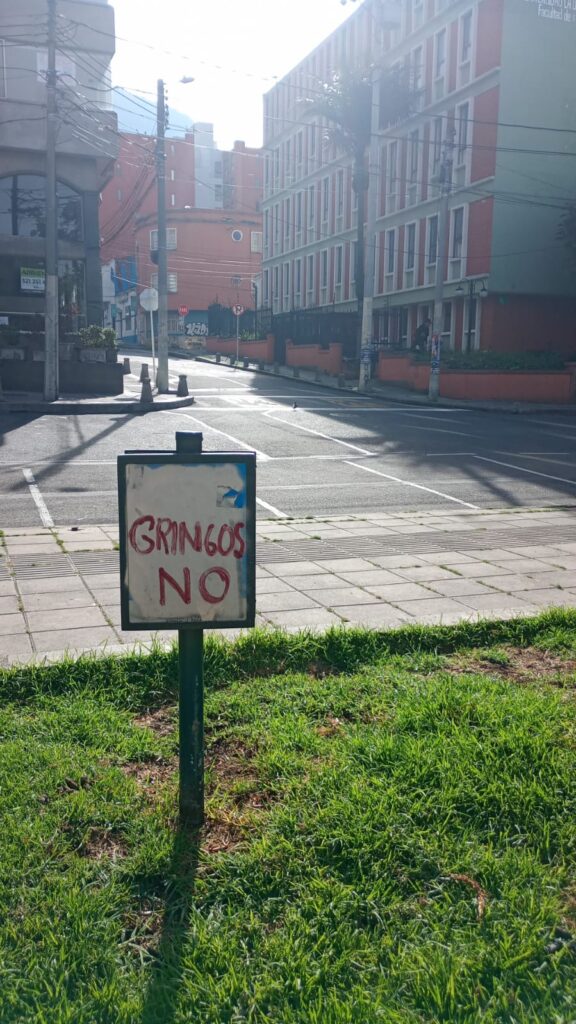
That’s not to say, though, that Colombians are wildly happy about the current situation. Colombia is a very different country to her neighbour, but there remains a relatively well-founded concern among many that there may be attacks on Colombian territory.
Anti-American sentiment is not exactly thriving, but graffiti and the like is already going up in certain parts of the city. There’s little to no appetite in the country for any US military activity in Colombia, even against cartels or guerrillas.
Worries still linger over the possibility of other repercussions. The waits for American visas have only just started to come down, with new appointments a year hence. Many worry that will increase again and that extant visas for expat Colombians may be affected too.
Tariffs, too, are never far from people’s minds, although Trump’s current position towards Colombia seems to be benign. Tourism will possibly be affected, both in the short and medium term.
Of course, Bogotá has a thriving Venezuelan expat community as well. While there is general delight at Maduro being arrested, there remain justifiable fears over what comes next. Delcy Rodríguez is seemingly no-one’s first choice and most hope for the promise of free and fair elections.
The Plaza de Bolívar and many others around both Bogotá and Colombia have seen large groups of Venezuelans gathering both to celebrate Maduro’s fall and to call for a transition towards a proper democracy. Most, however, are just getting on with life and wary of reading too much into things at present.
A particular trend has been for exiled Venezuelans to take to social media in order to decry what they often see as ‘Venezuelasplaining’. Many accounts are keen to point out that while the US might only be interested in oil, neither were China, Russia and Iran after arepa recipes.
As for other Colombian politicians, there’s been a mixed reaction. The Centro Democrático has had a well-coordinated and fierce response, aggressively trying to connect Petro and his allies to Maduro, with some success.
Others are resisting the temptation to use Venezuela as a political football, preferring to cautiously celebrate Maduro’s capture while expressing concern both about the manner it was done and the current political inclarity in the country.
What happens next?
For now, Delcy Rodríguez appears to be in control of Venezuela. She’s been sworn in as president and Trump says she’s committed to working with Washington. That means allowing US oil companies in, buying American goods and stopping shadow fleet sales.
While Trump had initially been dismissive of Maria Corina Machado, saying she had little support or respect in Venezuela, he’s changed his position a little and has a meeting lined up with her soon. This may be connected to her apparent offer to share her Nobel Peace Prize with him.
Regime enforcers have been on maneuvers throughout the past week to quieten internal dissent and quell momentum towards thoughts of a full democratic transition. The ELN has stepped up operations near to the Venezuelan border and Iván Mordisco has suggested a coalition of guerrillas to fight interventionism.
Plenty remains unclear about the whole situation. Trump has expressed a lot of opinions and thoughts but hasn’t elaborated on what the details behind any of it might be. There’s also a worrying lack of corroboration from other players.
Rodríguez and Petro haven’t really confirmed his takes on their talks, nor have oil companies definitively committed to full investment. At the moment, it seems like all parties are reasonably happy with the state of play but keeping options open.
Petro gets to play the plucky leader standing up to US imperialism, shoring up his party’s base at home ahead of coming elections while burnishing his reputation overseas. Trump gets to be the decisive commander in chief that took out a rival, while Rodríguez has received a promotion.
For now, it really could go in a number of different directions and small actions might be the things that push the country in certain directions. There are lots of cards on the table and plenty of big decisions to be taken.
Worryingly, the most likely scenario at the moment seems to be that the regime continues in power, just with a new leader and a new-found willingness, however reluctant, to work with the USA. For the ordinary Venezuelan, tragically, little much has changed as things stand.