Confused about the upcoming Colombian presidential election? We’re here to help you with a set of cheat sheets on the top candidates so you can follow the local news. Today we’re looking at Paloma Valencia of the Centro Democrático.
Who is Paloma Valencia?
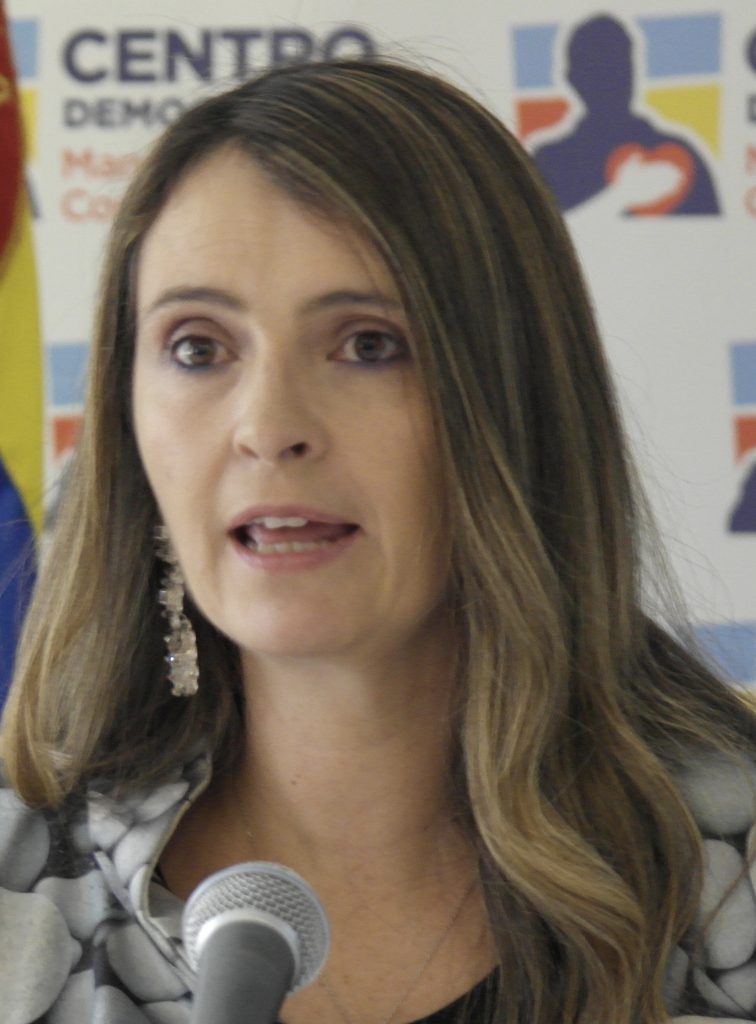
Paloma Susana Valencia Laserna is a conservative politician who has represented the Centro Democrático in the Senate for 12 years. She won her primary battle with three million votes in March, confirming her position as the establishment rightist candidate.
Anti-establishment types, look away now. Her paternal grandfather Guillermo León Valencia was President of the Republic from 1962-66, while her maternal grandfather Mario Laserna Pinzón founded the Universidad de los Andes.
Perhaps not coincidentally, that’s her alma mater, studying economics there before a Master’s in creative writing at New York University. She’s been heavily involved in politics for two decades now, originally as a candidate for Alas Equipo Colombia before jumping ship to the Centro Democrático.
Her faith is deeply important to her, as is tradition. Coming from the circle of the Popayán elite, she is a fairly standard conservative on most cultural and social issues. On the economy, she tacks more to a neoliberal line.
Is she polling well?
Not as well as she would like. While she won comfortably in the March primaries as part of the Gran Consulta por Colombia, she has since fluctuated around 15-25%, usually rising and falling in rhythm with rightist rival Abelardo de la Espriella.
Most recent polling has her in third place a week out from the election, which is a problem. She does outperform Abelardo in head-to-head matchups with Iván Cepeda in most polls, which her messaging will want to lean into over the coming week.
What’s her campaign like?
Centrism, slightly improbably. As one of two rightists in an election with a clearly dominant leftist candidate, two flailing centrists and a host of also-rans, she’s positioning herself as the closest to the centre of the viable options.
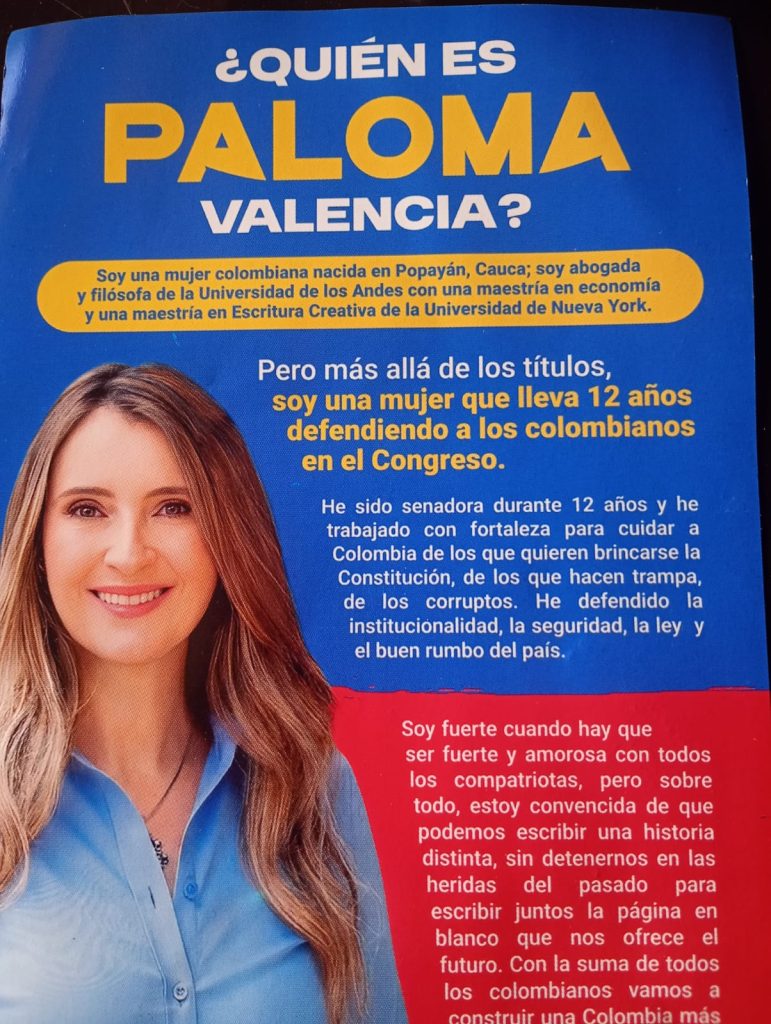
However, she’s firmly of the right, although tempered somewhat by her far more liberal vicepresidential candidate Juan Daniel Oviedo. This is best evidenced by the fact she is very much ‘la que dice Uribe’, clearly having the backing of the controversial yet still influential ex-president.
Her campaign logo features a cross, with religion playing a large role for her stance on many cultural and social issues. She leans heavily into those as a conservative. Colombia Más Grande is the slogan, but they don’t use it particularly well.
If elected, she would be Colombia’s first ever female head of state (with a first ever gay vicepresident too), although she’s not really leant into that much as you might think. As with much else, she’s not managing to cut through particularly well on socials or make a big splash in the national debate.
So what’s in her manifesto then?
You can read it for yourself online, under the name 111puntos. You even get an extra point for free. It’s fairly well presented, laid out and supported, but that’s not necessarily going to win any votes. Overall, other than a massive reliance on AI, there’s no big surprise or radical shakeup here, more a return to the old ways of doing things.
Paloma is certainly no dove when it comes to security and crime, promising a tough line. COP$20tn over four years for the armed forces in order to modernise and rebuild, finishing at 4% of annual GDP destined for the forces. That includes recruiting 30,000 more military personnel and the same number of police officers.
The rest of the money will go on increasing pay, conditions and so forth as well as a big push on tech. Drones are the centrepiece for investment, but cyberdefence is also highlighted as an area that needs urgent investment.
Slightly more old-school is her plan to militarise key transportation routes immediately. More of the same with coca farms: more spraying that allegedly won’t affect ecosystems or people, combined with subsidies for substitution. The fact that neither of those things have worked for decades isn’t stopping her.
On the other side of the coin, Paloma Valencia promises zero impunity: “el que la hace, la paga”. That means more powers to seize illicit gains and more prison sentences for those found guilty of corruption, reducing the number of casa por carcel sentences. 22,000 more penitentiary places and 19,000 more prisoners.
There will be 50 new casas de justicia and mobile courts to tour the country visiting rural locations that are currently not served by the legal systems. All of this is working towards an aim to get congestion in the system from 48% down to 0. Ominously, there’s also a promise of a law to “regulate protest and punish vandalism”.
New laws on corruption are to be brought in, mostly focused around greater transparency using tech. That means blockchain to record transactions and deals as well as AI to analyse potential discrepancies. There will be greater enforcement of existing regulations and a guardian of public integrity to oversee processes.
On the economy, it’s all about recovering confidence from the international market. That will be done by getting infrastructure and mining production back up to pre-pandemic levels (6%+), USD$10mn more in exports and growth over five percent annually.
More FDI to the tune of USD$2bn annually, 25% of GDP to go into internal investment and reducing the deficit by COP$50tn. How is she going to pay for all this? With, err, tax cuts for homeowners and businesses, efficiency savings of 25% and debt refinancing. Good luck with all that.
She’s the only candidate to really take the healthcare crisis seriously. First up is a promise to resolve 10 million blocked prescriptions, appointments and so on in the first 100 days. She plans to send doctors to patients in rural areas, not the other way round.
This will be paid for by a COP$9tn investment. A third of that is destined for delivery of outstanding operations and prescriptions, the rest for paying accumulated state debt to healthcare operators. Many taxpayers won’t like the latter.
Energy faces a similar situation: paying off state debts to operators within the first three months. The goal here is to avoid blackouts and brownouts in the short term, while putting in place structures to avoid the same issues over the long term.
Turning on the taps for both oil and gas lies at the heart of this plan, with a reboot of exploration and extraction projects. Partly, this is to attract AI database and server investment. There’s also support for renewables and alternatives, but it seems more of an afterthought.
Her plan on international relations is to ride two horses. Free competition with China and more co-operation on infrastructure and exports from Colombia. At the same time, leadership in Donald Trump’s Shield of the Americas project while guaranteeing that only the Colombian Armed Forces will operate in national territory.
There will be 187,000 free school places for talented children, 150,000 grants for vulnerable children and 10 public superschools. ICETEX loans, in line with other countries, will only be repayable when you have a salary. COLFUTURO will be rescued as well. The 16 biggest urban centres will have psycho-social units to look out for vulnerable children.
Businesses employing people under 28 will receive a subsidy of up to 30% of minimum wage for a year. Agricultural workers will receive better lines of credit, three million hectares of land formalised and a million new farming zones designated. Tourism is projected to double, with new routes opened for Asia and Europe.
There is a heavy focus on the grey economy. Informal workers will have access to seed capital, loans, a virtual wallet and a host of other possibilities. The goal is to offer help without persecution.
Pensioners will all be covered unconditionally, regardless of law or budget changes as well as three million vulnerable adults to receive subsidies. Each child born into poverty will have COP$500,000 put aside as seed capital to start saving.
Infrastructure starts off with 35,000km of new roads as well as increased satellite connectivity for marginalised communities. There will be 1 million new homes built, with a quarter of those directly subsidised. A million further homes will receive new or improved potable water access.
Finally, the environment. The brakes will go on for deforestation and the national parks will be protected from guerrilla activity. Local families will be given subsidies in order to protect areas of natural interest. Money generated from mining will be ploughed back into environmental protection.
Who is she running with?
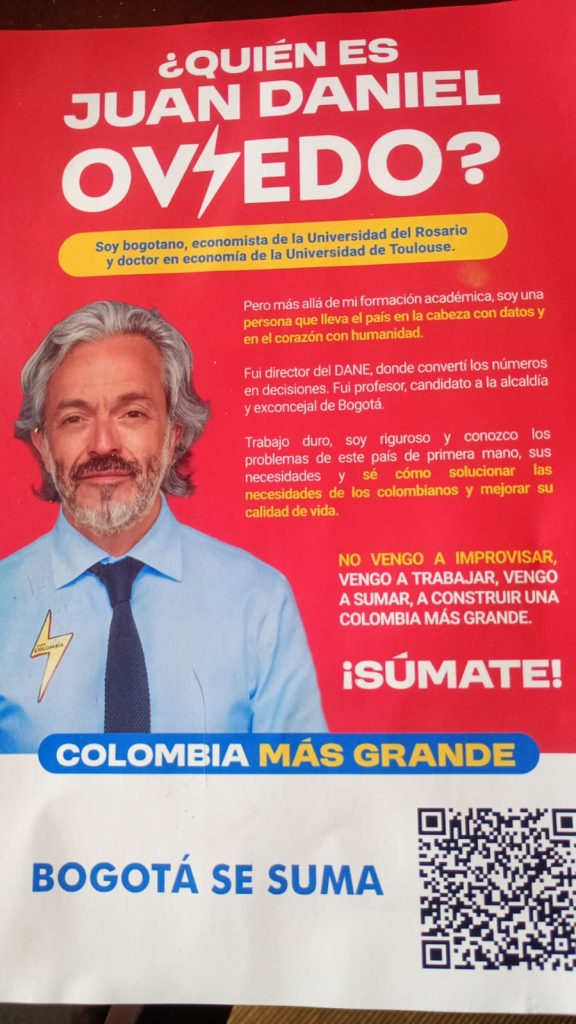
Juan Daniel Oviedo, former head of DANE and candidate in the last race for Bogotá mayor. In that contest, he managed to force Gustavo Bolívar into third place in a two-horse race, showcasing his impressive campaigning ability. He came second in the Gran Consulta with over a million votes, reinforcing his reputation.
He’s been more visible than Paloma Valencia for much of the campaign and is much more active than either of the other two undercards. That was the reason he was brought in – to appeal to more liberal voters and to provide an injection of energy on socials. He’s delivered in spades on both accounts.
However, there are a couple of issues here. Firstly, he runs the risk of overshadowing Paloma Valencia with his charisma and presence. Secondly, by joining her campaign he lost some of those centrist voters who saw it as a betrayal to join forces with the Centro Democrático.
They certainly aren’t natural bedfellows, with Oviedo a fair bit left of Valencia on a lot of economic issues. More profound splits are found on social issues. For example, Oviedo is out and proud while Valencia stands against gay adoption and marriage. Awkward at best.
Why do people say she’s ‘la que dice Uribe’?
That’s a bit unfair on a candidate with a long and storied political career of her own. However, while she isn’t just Uribe’s candidate, she certainly makes a lot of having his passionate backing.
That’s been a mixed blessing for a while now, with Uribe’s influence waning as the years pass. While his candidate won in 2018, they failed to even make the second round in 2014 and 2022 and we could well be on for a repeat of that.
The ex-president certainly casts a long shadow and that’s not always positive, especially with Oviedo also shining bright. Support for Uribe has dwindled over the past two decades, as Colombian demographics change profoundly.
However, Uribe does retain a large swell of support and also commands the biggest party machine of the candidates in the race. The Centro Democrático will be able to make a huge campaigning push on and offline across the entire country, which may be underreported.
Any skeletons in her closet?
A few, mainly over her combative social media use while in the Senate. Paloma Valencia has largely avoided serious controversy though, with most of her twitterstorms being differences of opinion rather than accusations of impropriety.
She accused now-president Gustavo Petro of corruption in 2018 following the Odebrecht affair. This amounted to grainy footage of him receiving cash at an unknown point. That was archived as being far too flimsy to be evidence of anything at all.
In 2022 she defended the Colombian state’s actions during the armed conflict, saying that while there may have been errors and atrocities, they were legitimate and in defence of the country. That unsurprisingly met with a huge backlash from various quarters.
There is one case hanging over Paloma Valencia still. Her link to Uribe led to her questioning the legitimacy of a key witness in the case against him. In turn, the witnesses defence lawyers filed a defamation case against the senator, over which the Supreme Court has ordered a conciliatory process. That has not yet concluded.
She’s also clashed with Cepeda’s vicepresidential candidate Aida Quilcué over indigenous rights in Cauca. Indeed, she’s gone as far as to suggest splitting the entire department in two, one for Indigenous Colombians only, something many view as racially motivated.
So, can she succeed?
Yes, she can. Next weekend is arguably a harder test for her than a second round would be if she gets through. Similar concerns swirled around her in the Gran Consulta por Colombia, but she ended up sailing through comfortably.
If she can repeat that trick, she matches up better than anyone else against Iván Cepeda. However, that’s very far from guaranteed, as they’re closely matched. It’s assumed that she’ll gain a lot of Abelardo voters, but that may not be true. The anti-left will flock to her, but the anti-establishment might not.
Her main draw is presenting herself as the only viable sensible candidate. In part that’s with Oviedo on board, in part that both Cepeda and de la Espriella are seen as populist. There’s a lot of centrist voters that will hold their noses and vote for her along those lines.
Having said all that, centrism isn’t in vogue in many places globally and Colombia is no exception. That may block her even getting to a final face-off and her chances of winning rest with anti-Cepeda votes. More than any other candidate, hers would be a loveless victory.