The results are starting to come in from around the country for the 2026 Colombian presidential election first round. Abelardo de la Espriella has outperformed expectations to win the first round with over ten million votes, facing Iván Cepeda in three weeks’ time
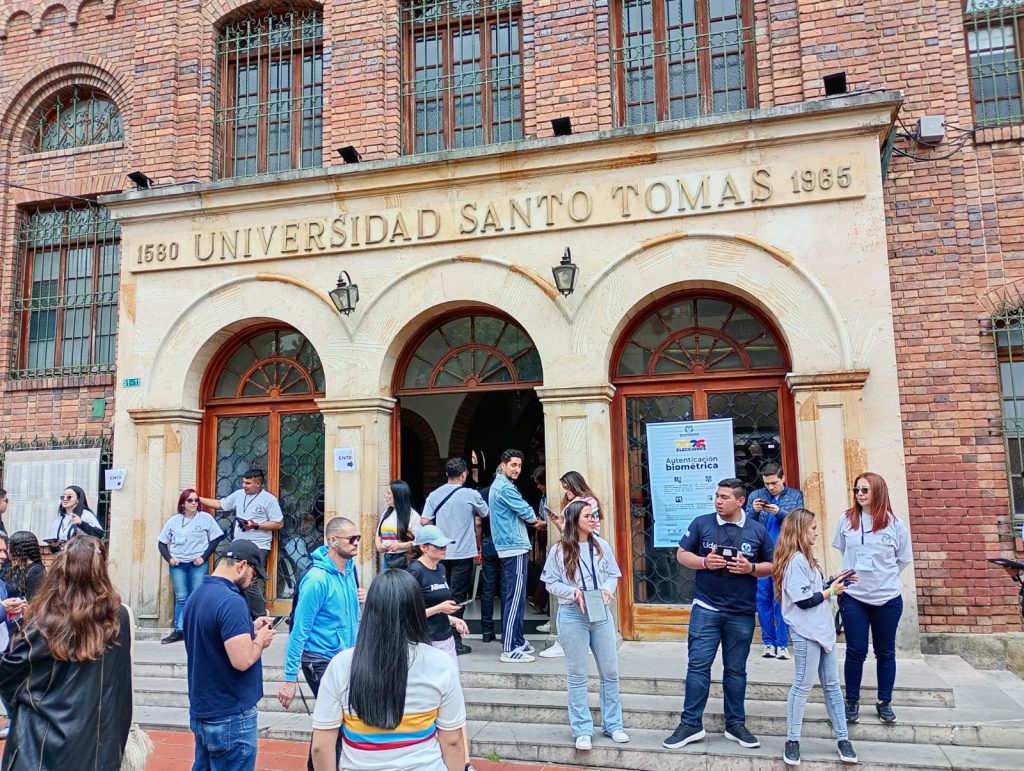
The ballot boxes closed at 4pm for the 2026 Colombian presidential election first round and now the tallying up of votes is underway. So far, with 99% of the votes in (19:30), Abelardo de la Espriella is outperforming expectations and has won the first round. He was expected to win between 25-30% of the vote, but now stands at 43.74%, significantly exceeding those predictions.
Read more: Abelardo de la Espriella Candidate Guide
In second place by a whisker is Iván Cepeda of the ruling Pacto Democrático. He was widely expected to come first with 40-45% of the vote and that’s where he appears to be (40.91%). The good news is that he’s matched expectations and that he’s against the candidate he most wanted to face in the second round. The bad news is that he looks set to finish second, is right at the bottom end of his target vote share and Abelardo’s performance has put the tiger among the pigeons.
Read more: Iván Cepeda Candidate Guide
The big losers of the day seem set to be the centrists and Paloma Valencia. The former are below even the extremely modest predictions they had been given, while the latter is performing beyond her worst nightmares. She had been expected to get at least into double figures, but is languishing at under 7%.
Read more: Paloma Valencia Candidate Guide
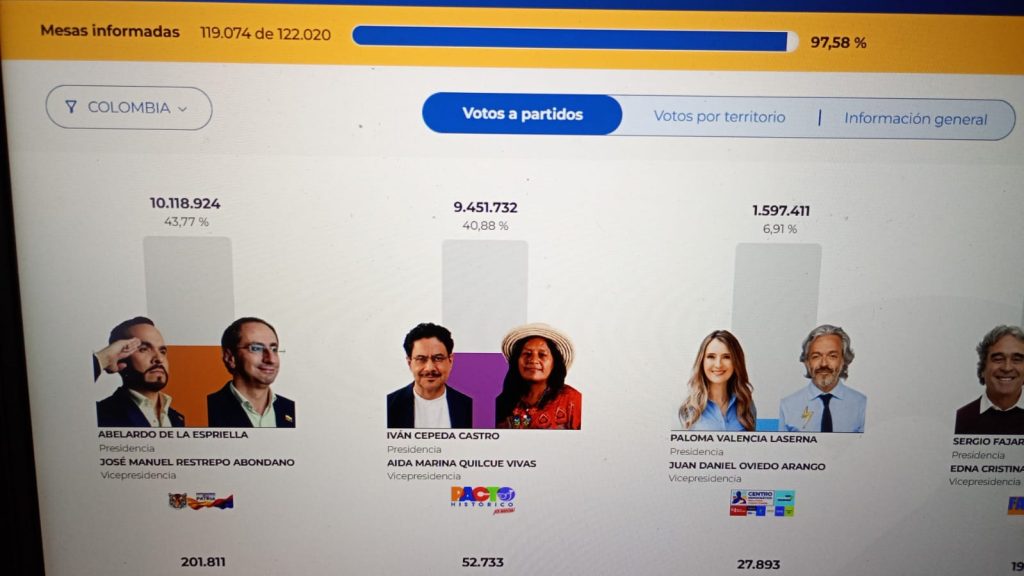
This is only the preconteo, so the votes will be formalised and fully scrutinised later. However, there is rarely a big change between the two numbers. There will still be heavy scrutiny on the data, especially with the focus on impropriety and accusations of vote-rigging (see below).
Only Abelardo de la Espriella managed to cross the symbolic ten million vote barrier, with Cepeda over 300,000 off the mark. With around 11 million votes needed for victory in the second round, things look promising for the self-styled outsider candidate.
Abelardo de la Espriella had been gaining momentum steadily in the last few weeks, but this is still a turn-up for the books and an extraordinary result for him. There is some speculation that a share of his vote comes from Pacto supporters that would prefer a run-off with him against Cepeda, but this seems unfounded.
There have been reports of private transport being laid on for rural voters to get to stations, paid for by both Cepeda and de la Espriella supporters in different regions. Supporters of both those candidates have also been accused of campaigning on the day and so forth in various reports from around the nation.
The collapse in the Centro Democrático vote isn’t hard to understand: Paloma Valencia had run a poor campaign and failed to get traction in the final weeks. What is surprising is the sheer scale of it: she’s ten to 20 points behind where she had expected to be. Questions will be asked in the Centro Democrático head offices now.
Elsewhere in the election, the dominance of de la Espriella and Cepeda left little room for anyone else. Sergio Fajardo ended his political career with over a million votes and nearly 5% of the vote, not too far off Valencia in the end. Failed Bogotá mayor Claudia López only got a quarter of the way to the 932,000 votes needed to recover her deposit. Hilariously, that’s about half the votes she gained in March’s primaries.
López did manage to squeak ahead of the reprehensible Santiago Botero, arrested in Cartagena on the morning of the election on domestic abuse charges. No surprise from a candidate who had been promising bullets for delinquents. Spare a thought, though, for Gustavo Matamoros in last place with a shade over 5,000 votes.
Turnout was higher than normal at 57.86%, with voto en blanco outranking all but four candidates and winning over 400,000 votes. As predicted, the Pacto won both coasts, the outer Amazon/llanos and Bogotá, while the right won all the central areas outside the capital. Dig deeper and the picture changes a bit: only de la Espriella won for the right, and Pacto’s vote share while winning was lower than expected in many departments (and Bogotá).
What happens next in the 2026 Colombian presidential election?
This means we are looking at a second round run-off on June 21st between Iván Cepeda and Abelardo de la Espriella, the two most polarising candidates on the tarjetón today. Whichever one triumphs, Colombia will have a lot of unhappy voters. It’s easy to assume that Paloma voters will flock to de la Espriella, but that’s far from guaranteed, given the divisive nature of the candidate.
We are likely to be in coin flip territory at this point – de la Espriella won around 600,000 more votes today, which is a selnder advantage. The million voters for Fajardo should mainly go his way, but again that’s far from guaranteed. He is no longer in pole position, but also not out of the race. Both candidates have a lot of work to do now.
With a relatively high turnout this weekend, it’s unlikely that there is a well of voters that will come out only for the second round, something that Cepeda will be hoping for. However, there are millions of non-voters who could make the difference if either candidate wins them over.
There are likely to be increased attacks on the electoral system from both the president and Pacto Histórico supporters. Petro has spent months questioning its validity and claiming that the system is opaque and unclear. Today has already seen a flurry of similar comments flooding social media with claims of impropriety in various places.
Oversight is carried out by the CNE (Consejo Nacional Electoral). In order to do this over the vast territory and number of stations, over 800,000 citizens are selected to be vote-counters. This is similar to jury duty in other countries and is compensated with a day off as well as a compulsory day of training a couple of weeks beforehand. As the electorate is growing, there are now some 13,000 voting sites across the country, most with multiple voting tables – 122,000 in total for today’s elections.
Petro’s concerns rest on the fact that Thomas Greg and Sons handle the software used in the election system, a firm that he’s clashed with repeatedly, especially over Colombian passport printing. He says that the systems are opaque and he has not received answers from the CNE or Registraduria over various concerns he has. However, both groups, along with Colombia’s neutral election observers MOE have been clear about the processes.
Online, there are many posts claiming that a key part of the alleged fraud will be in the reports made by the jurados. This echoes previous elections, where there was a flurry of images purporting to show electoral forms (E-14) that had been altered by the vote-counters. With AI entering the scenario, expect more of this after the first round, especially if de la Espriella or Cepeda do badly.
US senator Bernie Moreno, Bogotá-born, is in Colombia to observe the voting process, along with a significant number of international observers. Their reports will come through in the coming week, but this is only part of the story. Much of the voting irregularities here are hard to prove and difficult for outsiders to properly scrutinise.
Petro will also be under a keen eye from the electoral authorities and watchdogs over his involvement in campagining. The president is supposed to keep neutral throughout the election of his successor, but Petro has at best ridden that line very closely. He’s been accused on multiple occasions of crossing it, too, as have his ministers and Cepeda himself.
Whatever happens in the coming three weeks, the Bogotá Post team will keep you up to date with unbiased local reporting, free from vested interests or paymasters. Stay tuned to find out what twists and turns are coming in the 2026 Colombian presidential election race, as well as detailed profiles on the two candidates left in the race.